COMPLETED PROJECT / Kummelbank rendezvous position
Deslop and waste offlanding at Kummelbank
A combined waste removal scope covering 95 m³ of slops, 23 containers and six separately identified garbage streams.
THE REQUIREMENT
A combined waste removal scope covering 95 m³ of slops, 23 containers and six separately identified garbage streams.
Several waste streams in one coordinated requirement
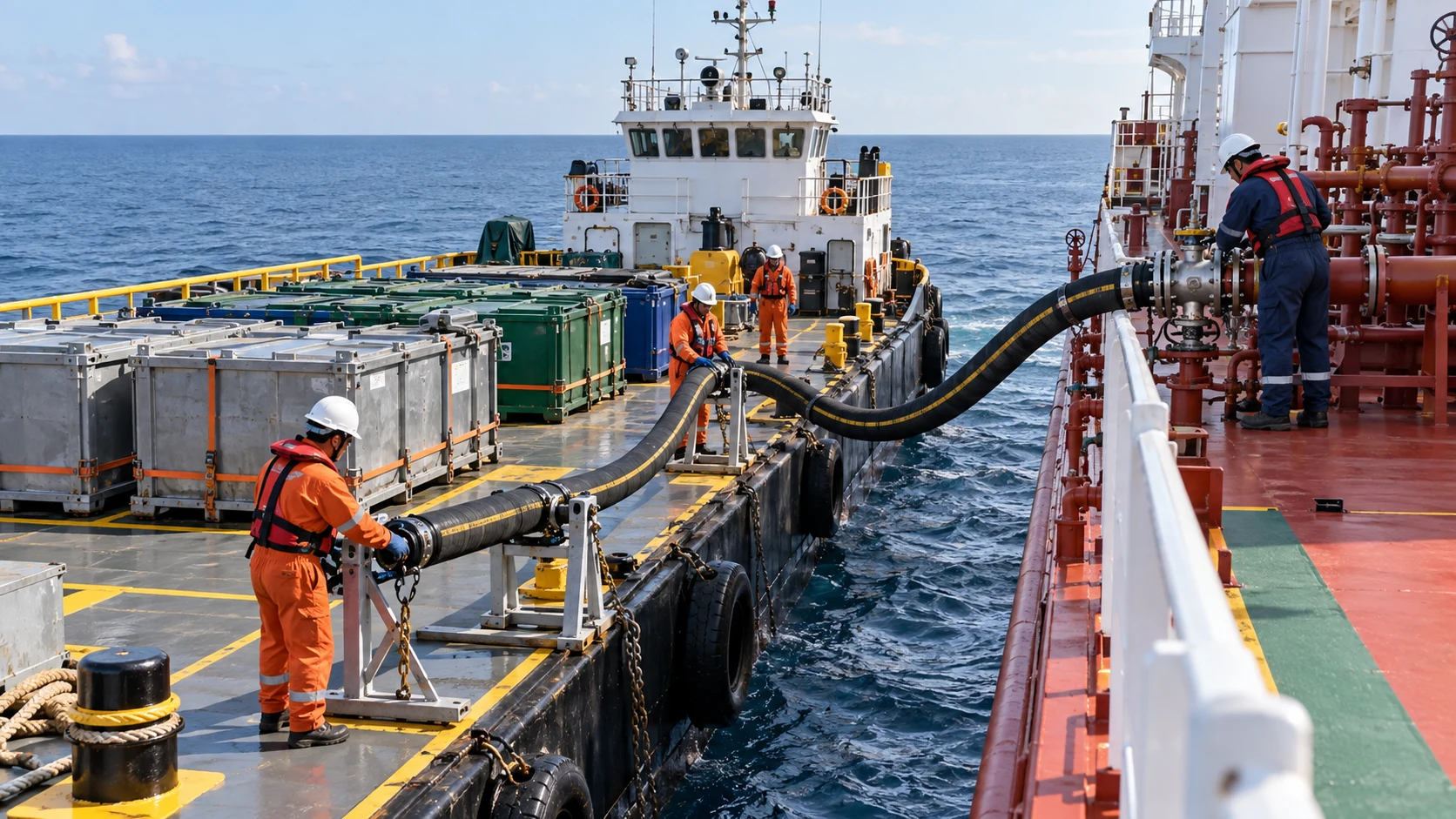
MSACHKL arranged a waste reception barge, deslop and waste offlanding services at the Kummelbank rendezvous position. The scope combined 95 m³ of slops with 23 containers and a separately itemised garbage list.
The container count comprised 15 open containers and eight with closed lids. Their number and configuration formed a separate handling requirement from the liquid volume. A container count should not be treated as an equivalent volume or assumed to describe the full deslop quantity.
The garbage inventory
The garbage scope comprised plastic at 1.8 m³, domestic waste at 0.3 m³, metal and glass at 0.2 m³, incinerator ash at 0.1 m³, oily rags at 0.2 m³ and electronic waste at 0.04 m³. Together, these listed garbage streams totalled 2.64 m³.
Keeping the streams itemised makes the requirement clearer for collection and reception planning. Liquid slops, containers, oily materials and electronic waste should not be described as one undifferentiated garbage quantity.
Technical context for the transfer
A rendezvous collection requires the vessel’s position and operating window to be considered alongside the waste inventory. Liquid transfer arrangements and container handling present different interfaces, so both need to be defined in the attendance scope.
IMO guidance on reception facilities emphasises the type and quantity of waste, transfer arrangements, segregation and containment identification. This context explains why a detailed inventory matters; it does not substitute for the actual collection documentation or receiving facility requirements.
The execution value
This project illustrates support for a combined waste removal requirement away from a conventional alongside delivery point. The completed scope included barge mobilisation and safe disposal arrangements, bringing together a substantial liquid quantity, a defined container count and multiple garbage categories.
For similar work, send the intended rendezvous position, schedule, waste descriptions, quantities and container details. Photographs and transfer connection information help establish the practical collection requirement.
TECHNICAL REFERENCES
IMO: Port reception facilities ↗IMO: Prevention of pollution by garbage from ships ↗Barge attendance and safe disposal as one service
MSACHKL arranged the barge for attendance at the Kummelbank rendezvous and arranged safe disposal of the collected waste. The task was therefore a reception and disposal operation, not simply a request to remove material from the deck. The liquid slops, containers and garbage categories had to be brought into one defined collection scope.
The barge is the working interface between the merchant vessel and the receiving disposal route. For liquid transfer, the relevant technical considerations include available receiving capacity, the nature of the slops, pump and hose arrangements, connection compatibility and a means of stopping transfer. These considerations explain the operation without assuming an undocumented pump rate, hose diameter or analysis result.
Liquid transfer and container handling are different workstreams
The 95 m³ deslop quantity is a receiving volume. It does not describe the weight of the 23 containers or their individual contents. Those containers require their own handling plan, including access for lifting, securing and the condition of the openings or lids. The 15 open and eight closed lid units were identified separately in the requirement for that reason.
The rendezvous location also makes the vessel position, communications and movement of the attending barge important. An offshore collection cannot be planned as though the ship were alongside a fixed waste reception point.
Segregation and the disposal trail
Plastic, domestic waste, metal and glass, incinerator ash, oily rags and electronic waste were listed separately. The oily and electronic categories carry a different handling context from ordinary domestic refuse; safe disposal arrangements need to reflect the waste stream actually received.
IMO’s reception facility guidance includes standard notification and waste delivery documentation. In a completed waste operation, the receiving information and the vessel’s records provide the link between the declared waste inventory and the material offlanded. MSACHKL’s scope connected barge collection with safe disposal rather than stopping at transfer off the vessel.
Return to selected projects →