A milestone for dry bulk shipping
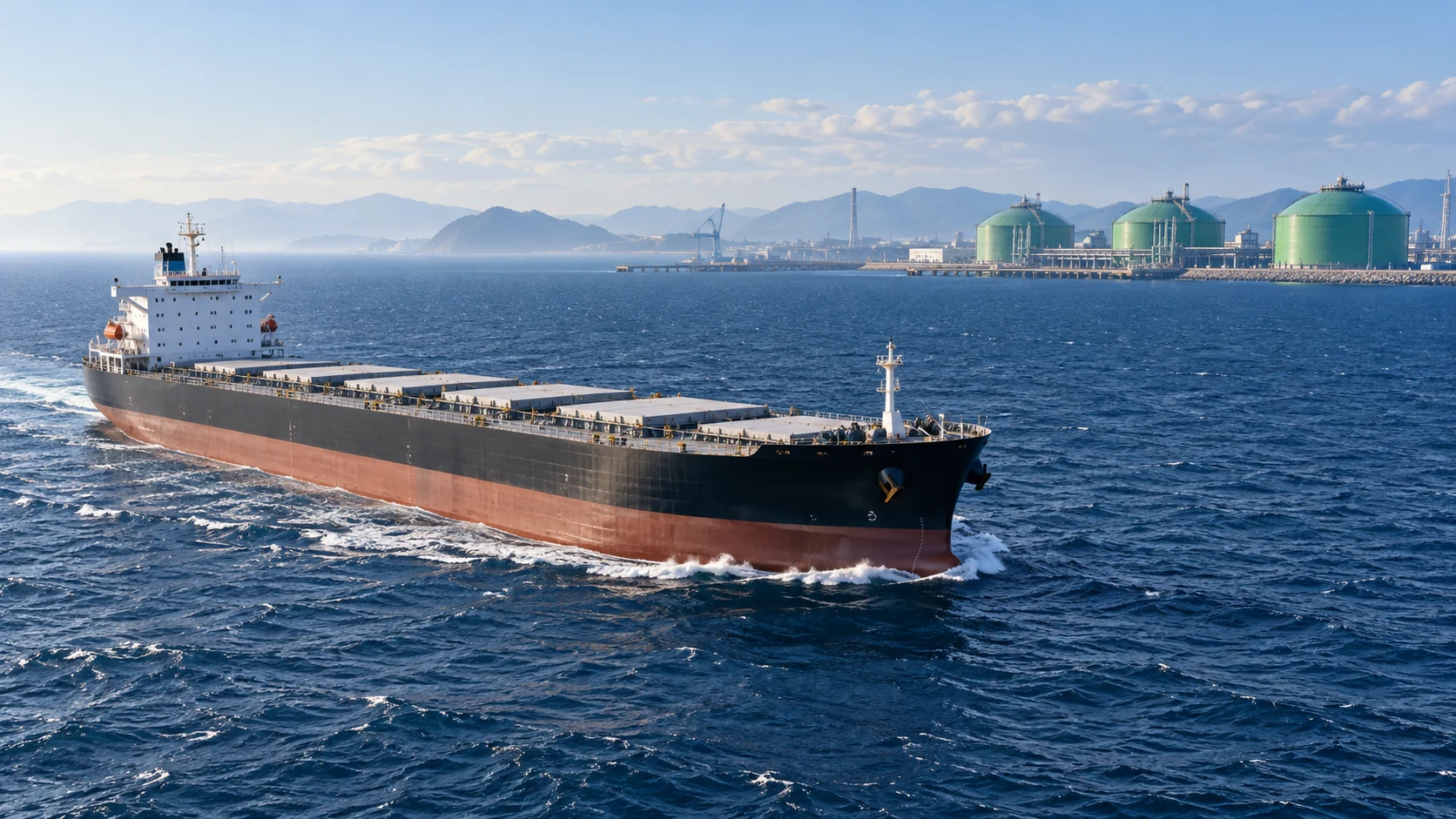
CMB.TECH announced on 9 October that Mineral Europa, its 210,000 dwt bulk carrier, had embarked on her maiden voyage to Australia following successful sea trials. The company describes her as the world’s first ammonia powered dry bulk vessel.
Built at Qingdao Beihai Shipyard, the vessel belongs to CMB.TECH’s Europa series. Her dual fuel engine can operate on ammonia and conventional marine fuels, providing flexibility while ammonia bunkering infrastructure develops.
The distinction matters. Mineral Europa represents a milestone for the dry bulk segment, rather than the first ammonia powered vessel across all ship types. WinGD reported the delivery of the ammonia fuelled gas carrier Antwerpen earlier in 2026.
The fuel transition extends beyond the engine room
Our assessment is that successful deployment will depend on the operating network around the vessel as much as the propulsion technology itself.
Owners evaluating ammonia should examine fuel supply commitments against their intended trading pattern. Managers need to establish which ports can support bunkering, what arrangements are required before arrival and how the vessel will operate if ammonia is unavailable.
Dual fuel capability provides an alternative operating mode. It does not remove the need to assess how conventional fuel use affects voyage costs and the emissions performance assumed in the business case.
Safety readiness must become operational readiness
Ammonia introduces significant toxicity and exposure hazards. ClassNK’s operational guidance addresses protective equipment, gas detection, bunkering arrangements and emergency preparedness. These requirements make readiness a practical responsibility extending across the vessel, shore management and attending personnel.
For managers, our recommendation is to examine how the approved arrangements will work during everyday operations. Who authorises access to affected spaces? How are contractors briefed? What happens when a detector fails, an alarm activates or planned maintenance requires a fuel system to be isolated?
Crew preparation also requires fuel specific competence. IMO identifies training for alternative fuels as a central part of the transition and reports the introduction of ammonia, methanol and hydrogen training frameworks in September 2025.
Maintenance planning needs a different level of coordination
From a vessel support perspective, the priority is to define the equipment, documentation and attendance requirements before a fault becomes an urgent port call problem.
Our practical recommendation is to establish critical spares with the relevant makers, confirm the suitability of replacement components and identify service personnel qualified for the particular installation. Materials, seals, instruments and protective equipment should be assessed against the approved system requirements.
A technically suitable spare is only part of the solution. Access arrangements, isolation procedures, installation competence and completion checks determine whether the intervention can be executed within the vessel’s available window.
Carbon free fuel does not mean every voyage has zero emissions
Ammonia contains no carbon, but the environmental assessment must extend beyond that characteristic. IMO’s lifecycle approach considers emissions from fuel production through onboard use and includes carbon dioxide, methane and nitrous oxide.
Owners should therefore evaluate the actual fuel production pathway and verified operating performance before making emissions claims. The relevant commercial question is the delivered environmental benefit across the operating profile, supported by credible records.
The MSACHKL perspective
Mineral Europa makes ammonia propulsion more tangible for dry bulk operators. Our view is that the immediate management priority is to build a realistic readiness plan covering fuel access, crew competence, maintenance requirements and technical support.
For fleets considering alternative fuels, early preparation should connect the equipment specification with the vessel schedule and the resources available at each port. That is where a technology milestone becomes an executable operating plan.
Dual fuel machinery is a system integration question
Ammonia propulsion adds a fuel handling and safety architecture around the engine. WinGD describes high pressure dual fuel technology for ammonia; the fuel supply equipment, controls and protective arrangements therefore belong in the readiness assessment alongside the engine itself. This general technology context should not be read as an unverified engine specification for Mineral Europa.
Managers need to understand the interfaces between fuel storage, delivery to the engine, ventilation, detection and emergency shutdown. A fault at one interface can affect the ability to operate in ammonia mode even where the conventional fuel mode remains available.
The maintenance plan should identify which tasks require specialist competence and which components form a practical onboard spare holding. Instrument sensors, control components and fuel system parts need to be selected against the approved installation rather than treated as familiar diesel accessories.
Bunkering readiness means more than a fuel supplier
A credible ammonia supply plan needs to connect a nominated source with the actual receiving operation. The vessel interface, receiving capacity, fuel specification, transfer arrangements and emergency communication require agreement before bunkering. Ports able to handle ammonia as cargo do not automatically provide a suitable marine fuel service for every receiving vessel.
CMB.TECH’s announcement includes investment in storage and bunker barges. That reflects the relationship between the vessel and its supporting infrastructure. The ship’s dual fuel capability provides flexibility, but its commercial ammonia use still depends on the delivery network available along the intended route.
Maintenance and exposure controls have to work together
Ammonia toxicity changes the working context for opening equipment and attending fuel related spaces. Isolation, depressurisation or draining where applicable, atmosphere verification and the protective arrangements must follow the approved system and vessel procedures. A routine component replacement should not bypass those controls merely because the part is small.
ClassNK’s operating guidance addresses protective equipment, gas detection and emergency readiness. For shore management, the practical implication is to connect contractor briefing, access arrangements and specialist competence with the maintenance order. The service plan needs to specify both the equipment work and the conditions under which personnel can carry it out.
The commercial assessment needs comparable operating assumptions
Owners should compare fuel pathways using an explicit operating profile: expected ammonia use, conventional fuel use, fuel availability, port costs, training and maintenance requirements. The headline fuel price alone does not describe the cost of operating the vessel across its trading pattern.
Likewise, the environmental claim needs a defined boundary. IMO’s lifecycle approach includes production and onboard use and covers nitrous oxide as well as carbon dioxide. A carbon free molecule does not automatically produce a zero greenhouse gas voyage. Verified fuel information and operating records are what make the assessment meaningful.
OFFICIAL SOURCES
WinGD: Fuel flexibility and engine technology ↗CMB.TECH: Formal announcement, 9 October 2026 ↗CMB.TECH: Mineral Europa vessel information ↗WinGD: Delivery of Antwerpen ↗ClassNK: Guidelines for Safety Operation for Ammonia Fuelled Vessels ↗IMO: Preparing seafarers for the energy transition ↗IMO: Lifecycle greenhouse gas intensity of marine fuels ↗Plan your next vessel requirement.
Discuss your vessel’s supplies, maintenance or technical attendance requirements with MSACHKL.
Discuss a requirement ↗